BIGUO (KS) Auto Parts Industries was established in 1990. It has become a reliable Strong Manufacturer in International market in the Field of Piston Pin and Cylinder Liner & Sleeve under the Brand name "BIGUO". Now we're the OEM suppliers for engine factories in Asia and Middle East. And we've cooperated with three famous international auto parts Groups.
Our factory
BIGUO (KS) Auto Parts Industries was established in 1990. It has become a reliable Strong Manufacturer in International market in the Field of Piston Pin and Cylinder Liner & Sleeve under the Brand name "BIGUO". BIGUO Auto Parts Industries is spread on 15,000 SQ. fts. land, well equipped with foundry and machining machineries and equipments.
Our product
We engaged in manufacturing PISTON PIN and Cylinder Liners & Sleeves for all types of Engines Applicable in Automobile, Tractor, Compressor,outboard, Generator, forklift,Earth Mover and Diesel Engine.
Quality control
We, at Biguo Auto Parts Industries strive to give good quality products at competitive prices in the identified global markets and provide customer satisfaction by consistently complying with specified requirements, continuous process improvement, involvement of personnel at all levels and upgradation of technology.
Production market
Since last 25 years BIGUO Auto Parts Ind. is manufacturing and exporting Piston Pin and Cylinder Liner & Sleeve of all type of Engines & Vehicles and being accepted in Domestic as well as Europe, America, Assia, Middle East & African market due to achieving International standard quality and implementing professional marketing and management system.


These precision piston pins are ISO 9000 and QS 9000 certified and statistical process control (SPC) is fully implemented throughout manufacturing.

The piston pin has an incredibly vital job, shuttling over 11,000 pounds of force up and down the bore.

In its most basic form the gudgeon pin is simply a piece of round bar. However, very few engines other than very basic, low-budget units – are equipped with solid gudgeon pins as standard.

Engine piston pins, also called gudgeon pins, or wrist pins, are used to link the small end of the connecting rod to the piston.

As a Cr-Ni series low alloy steel, after carburizing, quenching and low temperature tempering, the surface of DIN 15CrNi6 steel exhibits high fatigue strength.

The current study examined the plain fatigue and the fretting fatigue behaviors of the piston pin 16MnCr5 alloy steel under fully-reversed rotating bending loading.

Normalizing For piston pin 17CrNi6
Nominal normalizing temperature:850-880°C
Hold the temperature for several hours
Cooling in the air

If a power adder combined with higher specific output is on your agenda Trend offers a premium alternative to the H-Series that begins life using a much stronger H-13 Tool steel alloy.
It relates to a piston pin of an internal combustion engine, and particularly belongs to a semi-floating piston pin. The semi-floating piston pin is characterized in that arc guiding surfaces are manufactured at the tops of chamfers on two end heads of the piston pin. According to the semi-floating piston pin, the piston pin and connecting rods are guided through the arc guiding surfaces due to the fact that the arc guiding surfaces are added at the front ends of the chamfers, and then the connecting rods are transited to inclined planes firstly and finally to cylindrical surfaces, and therefore the whole assembling process is smooth and unhindered, and furthermore centering is easy.
Advantages of Semi Floating Piston Pin
Precision engineering
Each semi floating piston pin is meticulously crafted with precision engineering techniques, guaranteeing a perfect fit and seamless operation within your machinery.
Reliability
Trust in the reliability of our semi floating piston pins to keep engines running smoothly under the most demanding conditions. Whether it's for automotive or other related applications, our semi floating piston pins deliver consistent performance you can rely on.
Do You Know the Truth About Semi-Floating Piston Pin?
In this type, the pin is usually fixed relative to the piston by an interference fit with the help of a journal. These pins are secured to the middle of the connecting rod and the short end bearing of the connecting rod thus acts as a stand-alone bearing. In this pin, only the short end bearing is required for the bearing surface.
If this is required, it is provided either by electroplating the short end journal with a suitable metal, or a sleeve bearing into the short end eye, in which Interference fits with the orifice of small ends. During an overhaul, it is usually possible to replace this bearing sleeve if it is badly worn out.
In the reverse design, when the pin is fixed to the connecting rod instead of the piston. It is instead executed using an interference fit with the short end I, so the pin in the piston acts as a journal bearing.
These are complicated to manufacture and service because the two bearing surfaces or insert sleeves confuse the design. Also, the pin must be set properly so that the short-end eye is central.
In an internal combustion engine, the piston pin helps to connect the piston to the connecting rod and provides bearing support for the connecting rod to pivot when the piston needs to move. Or in simple words, the piston pin is a connecting link between the piston and the connecting rod. In most engine arrangements, including steam-powered engines, large stationary and/or marine engines, this pin is located in a sliding crosshead that usually connects to the piston via a rod.
This pin is a forged small hollow rod usually made of high-strength steel alloy. The pin design is challenging, especially in the case of small, high-revving automotive engines.
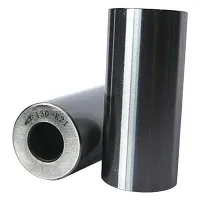
It looks almost the same as a simple cylindrical shaft, which can be solid or hollow. The ends of this pin have a chamfer. This pin is kept in the piston by a circular saw, while from the middle it is surrounded by the small-bore end of the connecting rod.
Generally, it is made of specially hardened steel and can withstand shear loads due to force transfer from the piston to the connecting rod. Well, it has very fine diameter tolerances for a perfect fit in the piston bore.
The gudgeon pin (piston pin) provides a smooth joint between the engine's connecting rod and the piston. The pin may be subject to high loads in alternating demands due to the oscillating motion of the piston, gas interaction, and inertial forces. In a gasoline engine, the rotary motion of the connecting rod relative to the piston must be balanced in the bearing locations of the pin, the pin boss, and the small end bore. Due to the small relative speed, the lubrication condition here is poor. In gasoline-powered engines with medium-specific output, the pin is fixed with shrinkage stress in the small end bore. This allows savings due to the elimination of the pin circle and the bushing being bored at the short end.
Whereas in diesel engines, this pin "floats" in the smaller end bore. It needs to be secured with a piston pin circlip to eliminate sideways motion in the piston pin.
How to Install Semi Floating Piston Pin
Semi-floating coupling is in the engine work, the piston pin and piston pin seat hole for clearance fit, while the piston pin and connecting rod small head for interference fit, the piston pin can only float in the pin seat hole, pin seat hole without snap ring, the two ends of the small head does not have to be fitted with connecting rod bushings, the piston pin parts of uneven wear.
When the engine works, the piston pin, connecting rod and piston pin seat have relative movement, so that the piston pin can swing freely in the connecting rod bushing and piston pin seat, so that the wear is uniform. In order to prevent the full floating piston pin axial movement scratching the cylinder wall, the piston pin is equipped with retaining rings at both ends for axial positioning.
Since the piston is aluminum piston and the piston pin is made of steel, aluminum has a higher thermal expansion than steel. In order to ensure high temperature work piston pin and piston pin seat hole for the transition fit, assembly , first the aluminum piston heated to a certain degree, and then the piston pin into the installation, this installation is more widely used.

When it comes to transferring the energy from the pistons to the crankshaft, semi floating piston pins have a pivotal role. Performance pins differ in materials, designs, weight and overall thickness from those found in production engines. The choice of materials, and how these are treated determine crucial factors in the performance of every gudgeon pin. Generally, pins are made from steel or steel alloys in what is known as carburising or case hardening. This improves stiffness and reduces wear by adding trace amounts of manganese, nickel and chromium. Further hardening can be carried out with nitride treatment, where the addition of chromium, aluminium or titanium, increases the stresses the pin can take before galling sets in. The same treatment is often applied to crankshafts where inherent strength and rigidity determine rotational speed and stiffness. This is in extreme loads, and higher rpms. Treated pins will always outperform those that are left without.
Varying levels of stiffness can be achieved through experimentation with wall thicknesses, especially in motorsport where combinations of other metals and alloys, besides steel, have produced interesting results.
Any damage to semi floating piston pins is a recipe for costly and irrevocable repairs, usually requiring the replacement of the whole engine. Semi floating piston pins, therefore need to have enough strength and flexibility to carry the loads at all engine speeds. Those that have been heat-treated and coated serve this purpose better. Pins also need to be precisely machined to the dimensions of the piston bosses, to reduce the likelihood of play and allow for optimal levels of lubrication. For performance pins, lighter is always better (without sacrificing strength). And where there are higher loads, as in upgraded or performance engines, pins that are easily serviced would prove beneficial and save time.
Our factory
BIGUO (KS) Auto Parts Industries was established in 1990. It has become a reliable Strong Manufacturer in International market in the Field of Piston Pin and Cylinder Liner & Sleeve under the Brand name "BIGUO". Now we're the OEM suppliers for engine factories in Asia and Middle East. And we've cooperated with three famous international auto parts Groups. Since last 25 years BIGUO Auto Parts Ind. is manufacturing and exporting Piston Pin and Cylinder Liner & Sleeve of all type of Engines & Vehicles and being accepted in Domestic as well as Europe, America, Assia, Middle East & African market due to achieving International standard quality and implementing professional marketing and management system. By strict monitoring of orders and developing stock plans in material, we maintain and deliver schedules in accordance to the requirements.

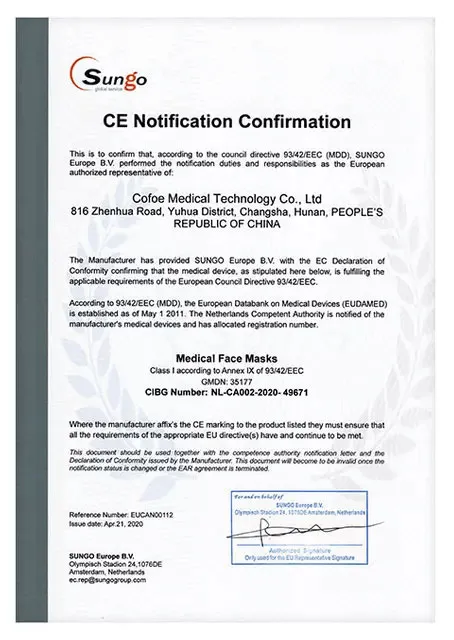
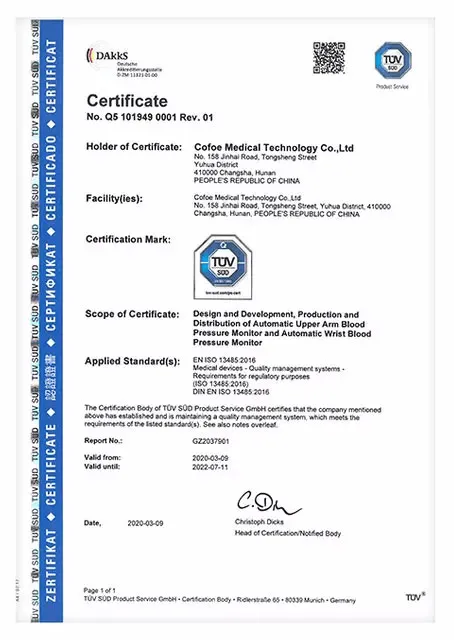
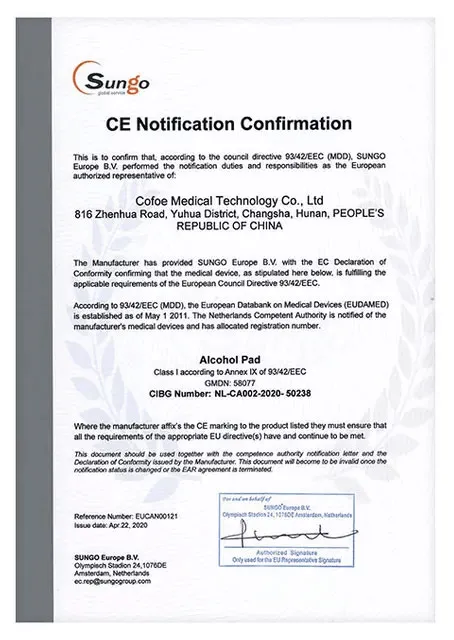
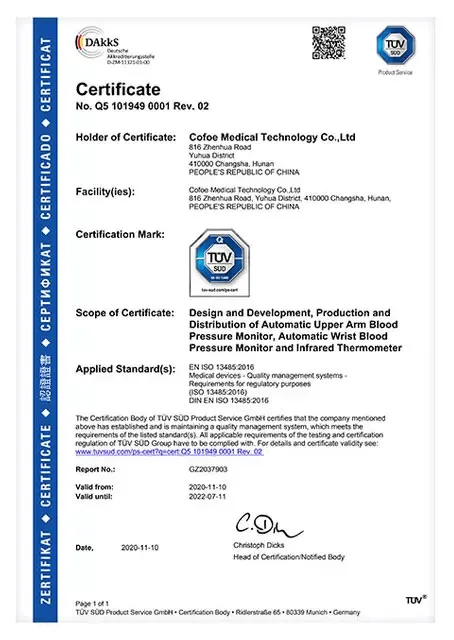
Certificate