



1. Function and working conditions of piston pin
The piston pin is used to connect the piston and connecting rod, and to transmit the force borne by the piston to the connecting rod or vice versa. The piston pin bears significant periodic impact loads under high temperature conditions, and due to the small swing angle of the piston pin in the pin hole, it is difficult to form a lubricating oil film, resulting in poor lubrication conditions. For this reason, the piston pin must have sufficient stiffness, strength, and wear resistance, with a minimum mass. The pin and pin hole should have appropriate clearance and good surface quality. In general, the stiffness of the piston pin is particularly important. If the piston pin is bent or deformed, it may cause damage to the piston pin seat.
2. Material and structure of piston pin
The material of piston pins is generally low-carbon steel or low-carbon alloy steel, such as 20, 20Mn, 15Cr, 20Cr or 20MnV. The outer surface is carburized and hardened, and then subjected to precision machining such as grinding and polishing. This not only improves surface hardness and wear resistance, but also ensures high strength and impact toughness. Ō
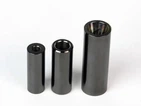
The structural shape of the piston pin is very simple, basically a thick walled hollow cylinder. Its inner hole shapes include cylindrical, two truncated cones, and composite shapes. The machining of cylindrical holes is easy, but the mass of piston pins is relatively large; The mass of the piston pin with two truncated conical holes is relatively small, and because the bending moment borne by the piston pin is maximum in the middle, it is close to an equal strength beam, but the machining of the conical hole is difficult.
The Function, Material, And Structure Of Piston Pins
Apr 02, 2024 Leave a message
Previous
Fixation Method Of Piston PinSend Inquiry